Gameplay
How to Play Cards in an NPC Tetramon Duel
TCG Card Shop Simulator how do I play a card guide: unlock the Workbench, prepare a legal deck, start an NPC duel and learn turn rules and win conditions.
Updated
- Guides
- 39
- Topics
- 3
- On this page
- 8
Prepare a deck and challenge a waiting customer
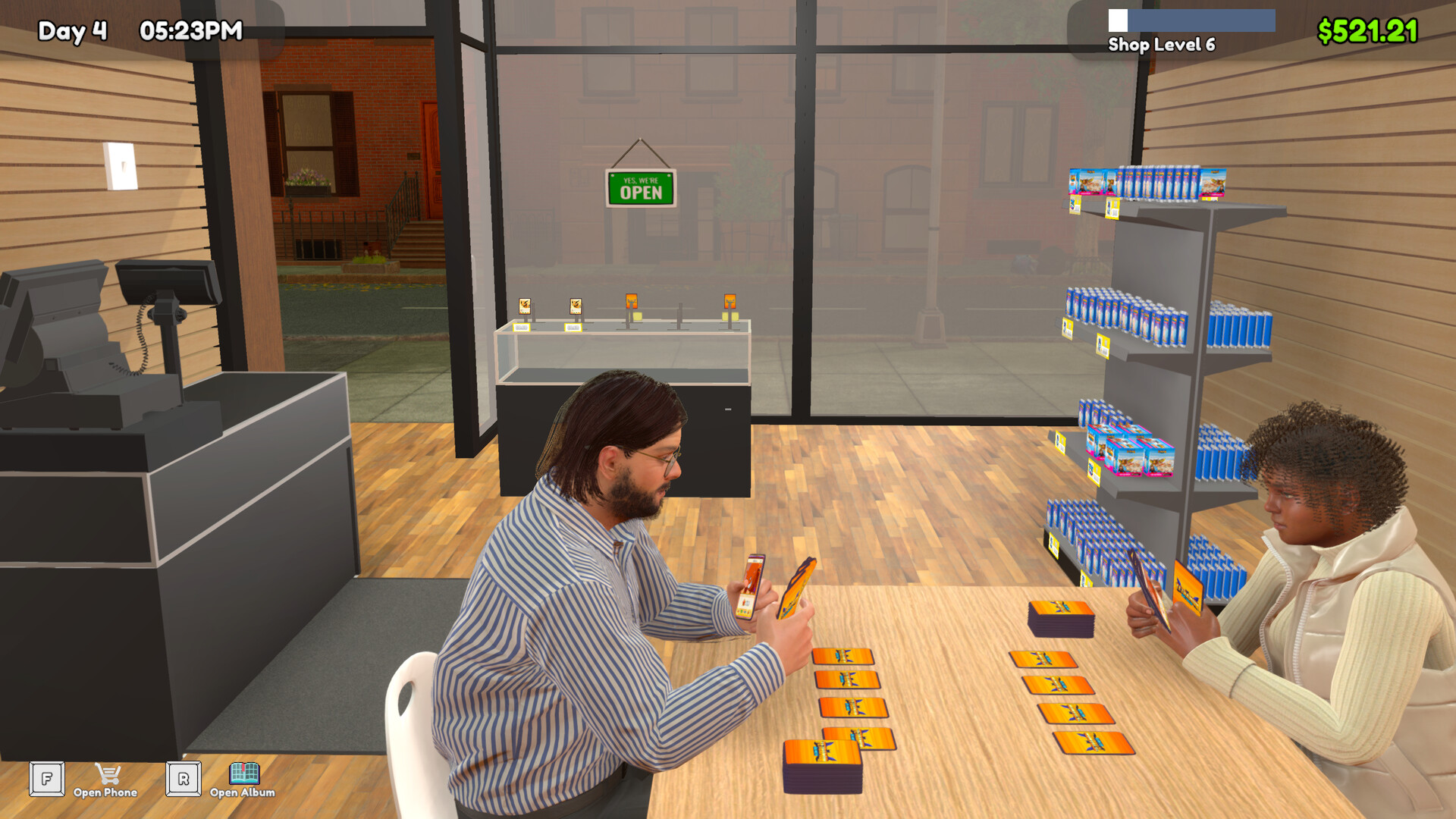
Unlock the Workbench at shop level 7 and construct and activate a legal 50-card deck to prepare for an NPC Tetramon duel. Approach a lone customer waiting at a Play Table and press the right mouse button on PC, or the indicated right face button on a gamepad, to start.
Use the Workbench to prepare for play
Version 1.0 introduced playable Tetramon matches against lone NPC customers waiting at Play Tables. A Play Table becomes available at shop level 2, while the Workbench and deck-building tools unlock at shop level 7. Having a table available earlier does not replace the need to prepare and activate a legal 50-card deck.
The Workbench lets you create or modify your deck and read the full in-game rulebook. Use it to prepare your deck before approaching a waiting customer. Keep the rulebook in mind as the place to check a particular card's play requirements whenever an action is unclear.
Start your first customer duel
- Create a legal 50-card deck at the Workbench so your deck is ready for a customer challenge.
- Activate the prepared deck before challenging a customer so the deck you intend to use is selected.
- Approach a Play Table with a lone customer waiting there to find an NPC opponent you can challenge.
- Press the right mouse button on PC, or the indicated right face button on a gamepad, to begin the duel with the waiting customer.
The shop continues operating while you play a customer match. These Tetramon matches are described as taking about 3–5 minutes. Choose a moment when you are comfortable turning your attention to the table.
Follow the opening and turn sequence
- Review your five-card opening hand and use the permitted mulligan if you want to change your start. This prepares your opening hand before the turn sequence.
- Follow the draw phase at the beginning of your turn. The turn proceeds through draw, main and attack phases before ending.
- Place Basic Tetramon into elemental slots during the main phase to develop your position before attacking.
- Evolve eligible cards during the main phase to continue an eligible evolution chain. A Basic played during that same turn cannot evolve immediately.
- Choose an allowed attack during the attack phase, considering elemental matchups and card effects. The starting player cannot attack on the first turn.
- End your turn after the attack phase to complete the turn sequence.
Check evolution timing and card effects
A newly played Basic cannot evolve immediately during the same turn. An evolution chain that is already eligible may be continued during the main phase. Check when the Basic entered play before planning your next evolution.
Attacks use elemental matchups and card effects. Read the card's effect text when planning what to do, and check the Workbench rulebook if an expected placement, evolution or attack is unavailable. Use those in-game rules to resolve the particular action you are attempting.
Watch Tamer Points and Guardian reveals
Each player begins with 500 Tamer Points and four face-down Guardians. Guardian reveals occur at the 400, 300, 200 and 100 Tamer Point thresholds. A player is defeated when their Tamer Points reach zero.
| Tamer Points | Meaning |
|---|---|
| 500 Tamer Points | Each player starts here with four face-down Guardians. |
| 400, 300, 200 and 100 Tamer Points | These are the Guardian reveal thresholds. |
| Zero Tamer Points | The player who reaches this is defeated. |
Check these restrictions when a play is unavailable
- Check whether you are the starting player on the first turn. That player cannot attack during that opening turn.
- Check whether the Basic you want to evolve was played during the current turn. A Basic cannot evolve immediately on the turn it enters play.
- Check that your prepared deck has the legal 50-card size before challenging a customer.
- Consult the Workbench rulebook when the placement, evolution or attack you expect remains unavailable.
Take your deck into a hosted tournament
Once you are comfortable with customer duels, you can also join a tournament you host. Your final ranking determines the prizes you can keep if you win. Practice the opening sequence and turn restrictions before taking your deck into tournament play.